
How Uber Prepares Its Ride-Matching App for Peak Hour Chaos 🚖⚡

New Year’s Eve in New York, Diwali night in Bangalore, or a typical Friday rush hour in London, millions of riders reach for the Uber app at the same time. Demand skyrockets, ride requests pour in by the second, waiting times begin to stretch, and the servers behind the scenes shoulder immense pressure.
And yet, the app almost never collapses. Your driver still shows up. Your fare is calculated in seconds.
👉 That reliability isn’t luck. It’s the result of AI-driven algorithms, resilient architecture, and some of the most advanced stress testing practices in the world.
This newsletter breaks down how Uber engineers prepare their ride-matching engine for the toughest conditions. 🌍
The Stakes Are High for Ride-Matching
Millions of ride requests per second across global cities
Rider trust is fragile a few minutes of app downtime can cost millions
Drivers depend on incentives to stay online during surges
Customer loyalty hinges on smooth pickup, fair fares, and accurate ETAs
Ride-matching isn’t just logistics it’s the heartbeat of Uber’s business model.
⚡ Core Challenges in High-Demand Scenarios
Handling global mobility at scale comes with unique challenges:
Dynamic Rider-to-Driver Ratios 🚦 - What happens when 10,000 riders request trips but only 2,000 drivers are available?
Route Optimization & GPS Accuracy 📍- Even small errors in pickup points can frustrate riders.
Scalability Under Load - The system must handle sudden traffic spikes during concerts, sporting events, or holidays.
Fair Pricing Models - Surge pricing has to balance supply incentives with customer acceptance.
Uber’s Ride-Matching Architecture
Uber uses advanced system design to keep things running smoothly, even during chaos:
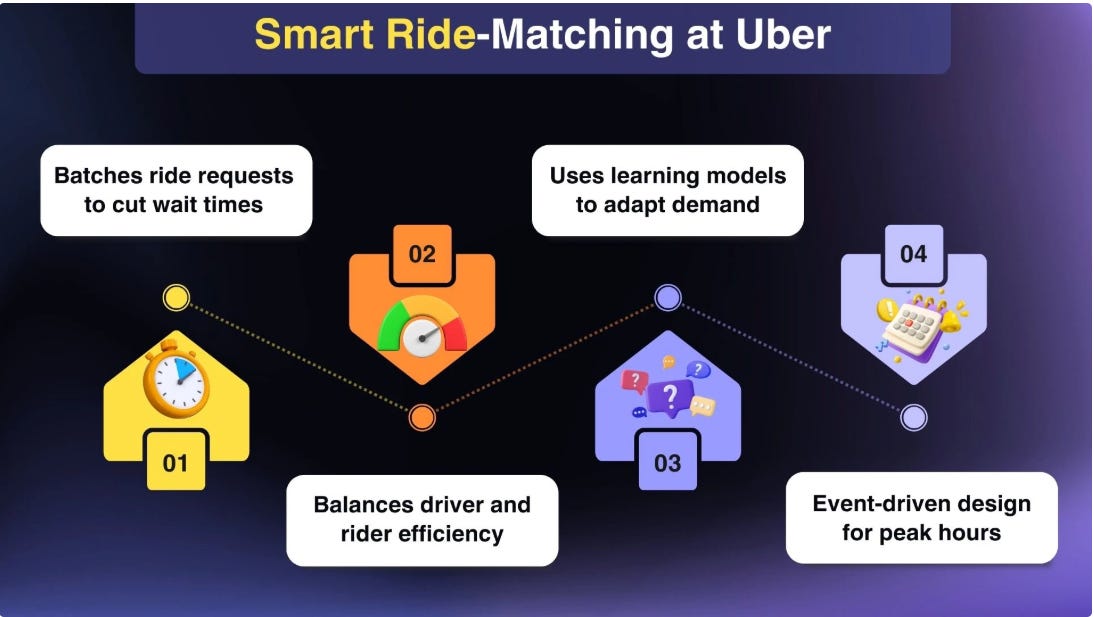
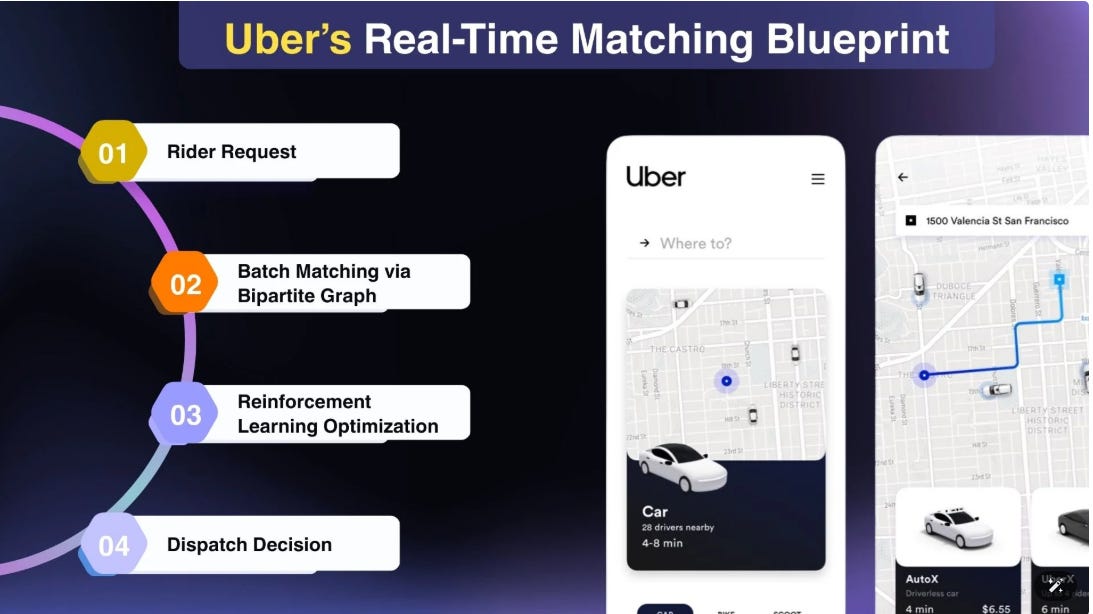
Bipartite Graphs & Hungarian Algorithm - Ensures riders are matched with the best driver quickly.
Machine Learning Forecasting - Predicts demand surges and pre-positions drivers accordingly.
Microservices & Redundancy - Distributed computing allows Uber to scale globally with minimal downtime.
Geo-Optimization - Heat maps, location clustering, and shortest path algorithms reduce wait times dramatically.🌍
This is why a rider in London and another in Bangalore can both get a seamless experience even though their traffic conditions, driver availability, and demand patterns look very different.
🛠️ Stress Testing Tools That Keep Uber Reliable
Behind Uber’s performance is a culture of relentless testing.
Hailstorm - Simulates peak traffic loads to validate scalability before real-world surges.
uDestroy - A chaos engineering tool that deliberately breaks parts of the system to test failover capabilities.
Shadower & Ballast - Capture and replay live traffic patterns, scaling them dynamically to test system behavior.
Load Testing (k6 & JMeter) - Validate response times, payment accuracy, and rider-driver matching efficiency.📊
Together, these frameworks ensure riders never feel the failures that engineers are constantly testing behind the scenes.
Why Stress Testing Matters
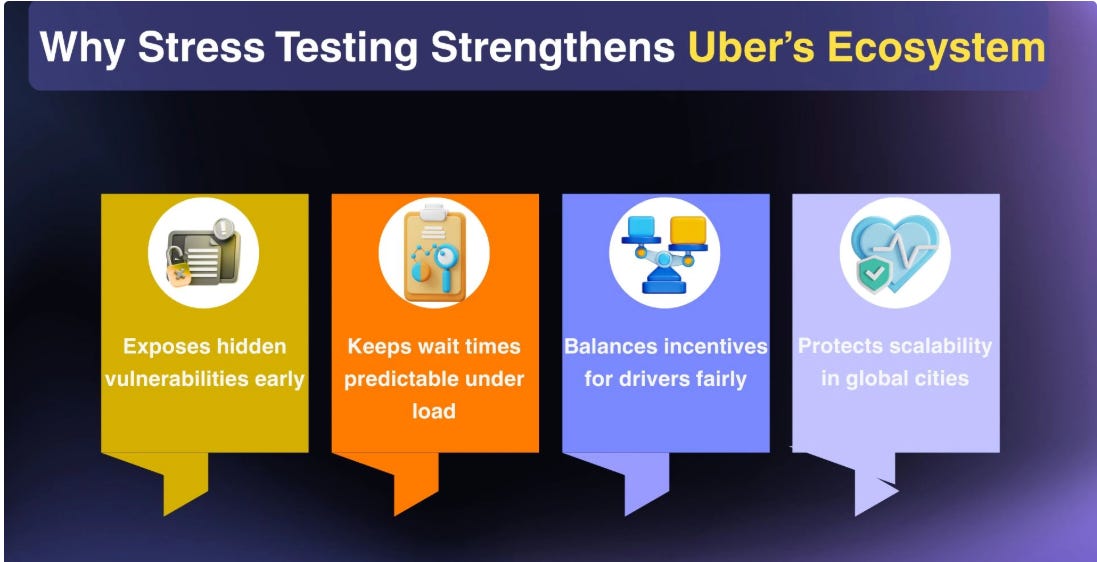
System Reliability - Prevents crashes in microservices architecture under global demand.
Customer Experience - Guarantees smooth logins, fast pickups, and accurate fare estimates.
Business Continuity - Ensures uptime across continents, no matter the surge.
Driver Efficiency - Keeps incentives and routing fair so drivers remain engaged during peak hours.
Stress testing isn’t optional for Uber it’s survival.
🚀 Final Thoughts
Uber’s ability to scale seamlessly during high-demand periods proves one thing: performance testing and resilience engineering are at the heart of every great digital experience.
Next time you tap “Request a Ride” during rush hour and your driver arrives without a glitch remember the hidden army of algorithms, load tests, and chaos frameworks working behind the scenes.
👉 We’ve unpacked Uber’s full strategy covering algorithms, testing tools, and future challenges in our latest blog: 🔗 How Uber Prepares Its Ride-Matching App for High Demand
This edition is part of the Frugal Testing Newsletter, where we decode how global companies like Uber, Google, and Netflix scale their systems for reliability.
👉 Talk with us: https://www.frugaltesting.com/book-a-meet